Showing posts with label China. Show all posts

Wednesday, August 29, 2012

Drum Performance at The Drum Tower: Rythmic Combination of Music and Chinese History


                     I find the Chinese way of drum beating fascinating , there's something about it that conveys a different message, unlike other drum beating performances in other parts of the world that sound merely celebratory. When I learned that there's a drum performance at Beijing's Drum Tower I thought it would be worth my time. I decided to spend my last afternoon in Beijing at the imposing tower in the northern part of the city , in Dongcheng District to be exact.


               As early as in the Han Dynasty (206 BC-220) in China, telling the time by drum played an important role in helping people live and work when there was no other way to keep track of the time. As a result, drum towers were built in almost every city throughout the country . The capital city's Drum Tower is a prominent structure.It is a two-storey building that is 48 meters high. The first floor is now used as an office,that's what a lady told us when we entered a room in the ground floor thinking that it was another exhibition hall.Actually, only the second floor contains the drums. Originally, there was one big drum and 24 smaller drums displayed on the second floor, but only the big drum remains.


               I had a limited time.I scheduled the visit to the drum tower few hours before my return flight to Manila so I had to rush.Good thing the tower was just a walking distance from the subway station.When I got to the ticket booth I was told that the next performance would be at 4:15PM. I hastily climbed the tower through the stairs and I tell you it's not for the physically impaired.The steps are incredibly steep and treacherous. I only had like two minutes to catch my breath before the performance would start.The drummers were already falling in line preparing for their entrance.I was surprised that the drummers were  teenagers.I think there were two girls in the group.Every visitor was quite but obviously excited.One of the drummers started to hit the biggest drum first. He started beating it slowly until the rest of the drummers followed suit by beating the smaller drums. After few minutes they started beating the drums fast.
The show turned out to be well-choreographed. It wasn't just a mere beating of drums.It was also like a rythmic combination of music and chinese history that we were watching and listening to.
The drummers were mesmerizing to watch. You can see their  intense passion for it. I was fascinated by their precise movements. Their hands moved rapidly and fluidly across the drums’ surface creating different sounds. It was definitely worth the 15 yuan that I paid for the ticket. I highly recommend this for those who plan to visit Beijing.


Thursday, August 16, 2012

Qianmen , Another Glimpse Into the Old Life in Beijing

        While doing my research for my trip to Beijing I came across photos of a street lined with buildings that resembled old chinese structures. I found out that it is an old mercantile centre of shops in Beijing. Qianmen runs from Jianlou (the Archery Tower) of Zhengyangmen in the north to Tiantan Park in the south.  The street is lined with buildings whose architecture resembles the buildings in the late Qing Dynasty 1644 --- 1911(although I doubt if the buildings are the original structures since there were a lot of demolition that took place in the area before the Olympics).These nice structures are still used as restaurants ,and now some are souvenir stores and shops that house international brands.

       For those who love to shop they can squeeze in a few hours of shopping in their "sightseeing time" as it's easy to drop by at Qianmen.It is near the famous Beijing landmarks and tourist spots like Tian'amen square, Forbidden City and Temple of Heaven. The prices in the shops of Qianmen seemed to be more expensive though compared to the other shopping area of Beijing. There were shops in the Wangfujing area where I bought some souvenirs and a scarf from and the asking prices were lower than the ones in Qianmen.If you couldn't afford to shop at Qianmen you could just marvel at the nice buildings that would make you feel like you've time traveled back to the 17th century. You will also enjoy checking out the interesting and colorful knick knacks inside the souvenir shops.
        Aside from the shops another good reason to visit Qianmen is the gate in Beijing's historic city wall called Zhengyangmen ( Qianmen is actually the colloquial name for Zhengyangmen). 
Zhengyangmen was first built in 1419 .It's consisted of the gatehouse proper and an archery tower. The gate guarded the direct entry into the imperial city. I wanted to go up to the imposing tower but a lady told me that tourists were not allowed ( at least that's how I read her hand gestures). I envied the kids who were waving at everyone below , I wondered how they had gotten up there.The city's first railway station, known as the Qianmen Station, was built just outside the gate.                              
                             

Railway Museum                          
                             

Saturday, July 28, 2012

Temple of Heaven

                     I'd planned to spend my last day in Beijing at the Temple of Heaven , Summer Palace, Qianmen and at a Hutong ( hutongs are narrow alleys formed by lines of  traditional courtyard residences) .At around 5:30 AM , I packed my things and prepared to check out. I had a problem though , check out time was at 12 noon yet but I wanted to tour the city first thing in the morning ( until it's time for me to head to the airport around 8pm to catch my flight back to Manila).I didn't want to leave my backpack in the hostel and be interrupted with my tour at around 12 noon just to get my bag and check out. On the other hand , If I checked out early I'd have to carry my backpack all day while touring the rest of Beijing.The staff advised me that I could actually check out early and I could just leave my bag in their storage room and just pick it up before I head to the airport.                
               After checking out , I made my way to the Tianamen East subway station. It's quite a long walk. The directions provided by my hostel ( Peking Youth Hostel) in Beijing says that it's 200 meters from the subway station but it felt like 500 meters. What I loved the most about my hostel was its location which is right smack in the middle of Beijing, to the east of the Forbidden City. Yes, they were neighbors with the Emperors.  I took the subway from Tianamen East station , and I got off at the Tiantan Dongmen station which is the closest station to the Temple of Heaven. 
                          
                            The Temple of Heaven is a complex of Taoist buildings constructed from 1406 to 1420. It was in the complex where the emperors of the Ming and Qing dynasties would go to pray to heaven for good harvest, to be exact at the"Hall of Prayer for Good Harvest"( redundant?). The Hall of Prayer for Good Harvest is the most popular and most photographed structure in the complex. It  is a magnificent circular building, built on three levels of marble stone base.The surroundings of the Temple of Heaven is also a very popular park among the locals where they take part in different activities. Another reason why I really wanted to visit this place.


                          I paid 30 yuan for a combination ticket that gave me access to all sections and buildings of the complex. As I made my way to the Hall of Prayer for Good Harvest I was welcomed by the sight of a park teeming with locals , as they start doing the activities of their choice .I was entertained by watching elderly women happily dancing to Chinese music in one corner and another group doing Tai chi in the other. There was also a part in the park where some exercise equipment where put up for the elderly men and women to use. I was amazed at how fit and flexible those old folks are.
                              

                            From the park of the complex, I walked through a long corridor on my way to the Hall of Prayer for Good Harvest. Lining the corridor were groups of elderly again. Each group formed a circle.I was intrigued so I checked out one of the groups and I found out that they're playing card games. 
Grandmas and Grandpas playing card games early in the morning
                               
                             When I reached the Hall of Prayer I didn't feel the same thing I felt upon seeing Angkor Wat in Siem Reap and Wat Arun in Bangkok for the first time. It wasn't stunning. It looked pretty much the same as in the photos I had seen. Somewhere in the complex there's another building that serves as a mini museum. It displays old photos of the Temple of Heaven in its early days. At least this time I enjoyed looking at the black and white photos depicting the renovations done for the Hall of Prayer. There were also photos of leaders from all over the world visiting the complex.
               The architecture of the buildings in the Temple of Heaven is new to me but it's the activities of the locals in the morning that I enjoyed more during my visit. 

                   
Interior of the Hall of Prayer for Good Harvest

Thursday, July 5, 2012

Olympic Green : The Bird's Nest, Water Cube and everything about the 2008 Olympics

           Beijing National Stadium, also known as the Bird's Nest served as the venue of the 2008 Beijing Olympics opening ceremony as well as the closing ceremonies,athletic events and football finals.It has become one of the most famous landmarks in the world. Documentaries were shown about its construction and a lot has been written about it. People from different parts of the world raved about its unique design which is inspired by what else? a bird's nest. 
          When I was creating my itinerary for my Beijing trip I made sure there'd be enough time allotted for the stadium and the entire Olympic village also known as the Olympic Green. I'd seen a lot of photos of tourists taken in front of the stadium but I was intrigued about the inside. I wanted to feel even just a fraction of what those lucky spectators of the opening ceremonies of the Beijing Olympic Games felt while watching the spectacle inside Beijing's newest architectural wonder.


                After relishing the panoramic view of the Forbidden City and other parts of Central Beijing from the Jingshan hill I went down to the street east of the hill and from there I took the looong bus (yes, they have those long buses in Beijing whose length is equivalent to the length of two regular buses) to the nearest subway station on my way to the Olympic Village. The bus passed by the Drum Tower but I thought I didn't have enough time to explore both attractions that afternoon so I decided to spend the rest of the afternoon for the Olympic Village alone.I got off near the Drum tower and I had a hard time finding the nearest subway and eventually I got lost.I regret asking directions from a young chinese couple because they pointed me to a regular train station which led to more confusions and charades.No way! we did this in Bangkok already.Finally, I found a subway station. I paid 2 RMB for the ride to the Olympic Village.The good thing about Beijing's subway is you only pay 2RMB regardless of where you are going,even if you make several transfers from one line to another.
          I arrived at the Olympic Sports Center Station around 2pm.Before coming out of the station I was looking forward to that "WOW! moment" that I experience every time I see a famous landmark for the first time.Same feeling I got when I saw Angkor Wat and Wat Arun. The Bird's Nest didn't fail me. From the subway station I had to walk quite a distance to the stadium.I paid 50 yuan to get inside. It's actually a lot bigger inside than how it appears from the outside.While inside, I could imagine what it must have felt like during the Olympics 2008 when you're just one of the 90000 or so people (which is the capacity of the stadium) watching the opening ceremony and other events during the games . I checked out the view from the top most bleacher and in that section I realized the enormity of the structure. I sat there for a while and all of a sudden I felt lonely. The emptiness of the stadium and the hazy Beijing afternoon I think rubbed off on me so I went down and explored other areas.


            Below the bleachers are shops selling olympic souvenirs and a room displaying wax figure of the Olympic officials.There was also an exhibit of the musical instruments used during the opening ceremony of the Olympics at the stadium like the famous drums that were lit up during the countdown at the beginning of the show. 
One of the drums used during the Opening Ceremony of the Olympics 
             After exploring the stadium, I waited for the structures in the Olympic Green to be lit up. While waiting I observed the different activities in the area. There were people flying kites and some were just sitting at the benches surrounding the different interesting scupltures on display at the Olympic Village. I also went to the other side to check out the Water Cube aka The National Aquatics Center which served as the venue of the water sports during the Olympics.I learned that it had been converted into a water theme park.The Water Cube is so beautiful when it's lit up and it's nice to see the color change every couple of minutes. 
              Almost four years have passed since the Beijing Olympics and still a lot of people are interested to see the Bird's Nest and other structures within the Olympic Green that were once witnesses to another milestone in China's colorful history. 
                  You have to visit it now before they convert it to a mall.That's what I've heard.
Park around the stadium


Water Cube
Admission Fee:    CNY50 for a visit to the National Stadium
Opening Hours:   9:00 to 18:00 on weekdays
                             9:00 to 21:30 on weekends and public holidays.

How to get to the Olympic Green : 

By Subway: 

Take Subway Line 10 to Beitucheng then switch to Subway Line 8 (Olympic Special Line): get off at Olympic Sports Center Station, get out of the station from Exit B1 (northwest exit) or Exit B2 (northeast exit), and walk north to Bird's Nest.

By Bus :

Take bus 82, 538 or 611 and get off at Guo Jia Ti Yu Chang Dong (National Stadium East) Station.
Take bus 18, 108, 124, 207, 328, 380, 387, 409, 426, 558, 653, 694, 758, 803, 849, 985 or 特2 and get off at Ao Ti Dong Men (Olympic Sports Center East Gate) Station.
Take bus 84 or 407 and get off at Ao Ti Xi Men (Olympic Sports Center West Gate) Station.

Saturday, June 16, 2012

Treasures of Forbidden City

                  The Forbidden City is so massive and has several courtyards , you enter a courtyard to be led to another one that looks almost the same as the last one. If all that was left in the palace was just the courtyards surrounded by walls then there's nothing much to see. But when I did some research about the palace I learned that there's a section that contains some interesting artifacts of various types including ceramics ,jewelry, paintings , jade sculptures , and bronzes. I paid an additional fee of 10 RMB to see these interesting collection. I was surprised that there were ceramics as old as a thousand years.The jewelry worn by the royalties were also on display and not just ordinary jewelry but really expensive ones like diamonds.Since there are thousands of artifacts in the Forbidden City the exhibits are changing from time to time so don't waste your time looking for those items that you've seen on this blog that might not be on display at the time that you visit the palace .There were so many things to see and of course so little time.
phoenix crown


I didn't know what this was but believe it or not it was labeled "pillow".

belt

golden globe
      
This sculpture is made out of jade and is taller than me.

Tuesday, June 5, 2012

Forbidden City No More

          Located at the center of Beijing, Forbidden City was the home for emperors during the Ming and Qing dynasties. It is a vast palace complex , in fact , it is the largest in the world. According to books it has thousands of rooms. The distance between its southern gate and northern gate is 960 meters. Having known this I had prepared myself for a walkathon that I'd be getting myself into.One of the preparations I did was studying the Beijing map. In the early days , ordinary people were absolutely forbidden to enter the city and if one got caught he'd be sentenced to death. Nowadays, for an entrance fee of 40 RMB anyone is allowed to explore the complex ( some parts though are still restricted to tourists ). The Forbidden City has become one of the main tourist attractions in Beijing. Unfortunately , I had to schedule my tour of the palace complex on a Saturday , a day when more people are expected to visit the palace than any other days of the week.
Side of the Forbidden City facing Tian'amen Square
        To avoid the crowd I'd planned on exploring the Forbidden City when it opens at 8:30 AM. I got up early but I went to " The Egg " first , (yes, if there's a structure called the " Bird's Nest", there's also one called "The Egg", aka The National Center for the Performing Arts) which is located just across the street from the Forbidden City.


       It was already 9 AM when I got to the palace complex. I passed through the Tian'amen gate (technically not part of the Forbidden city) and stared at Chairman Mao's portrait hanging on the gate. I was trying to measure it in my head. It's really a huge portrait but visitors can't get close to it. I walked northwards until I reached the Meridian gate where I bought my ticket, maps of the Forbidden City were also sold at the gate.Surprisingly , despite the number of people visiting the complex that day I didn't have to queue up to buy my ticket and to enter the complex. Inside I was trying to imagine what it was like then during the Ming and Qing dynasty. I could just picture Chinese warriors marching in the courtyards , or the members of the Imperial family watching the activities in the complex from the balconies of the gates. Everything inside the Forbidden City was just grand. I was overwhelmed by the tall gates , the high and thick walls and the massive courtyards. All the buildings, gates and courtyards almost look the same though. You enter a courtyard only to be led to another one that looks similar from the last that you wish it would end already so you could rest from the leg-breaking excursion.
Touching the Golden Knobs on the doors of the Forbidden City is believed to bring good luck


         I got to enter some of the buildings that had been converted into exhibition halls like the one that displays ceramics that are hundreds of years old. Another hall displays old canopies used by the emperors during ceremonies. I also paid an additional fee of 10 RMB to enter another section of the complex that displays the treasures of the Forbidden City like crowns, jewelry and other accesories (made of gold, pearls, and precious stones) used during the Ming and Qing dynasties. There was just too much to see inside the Forbidden city that it took me 4 hours to reach the Imperial garden at the northern end of the complex. 
large bronze vats were used to store water to extinguish fire
         The Imperial garden was not to be missed as it had been a witness to several important events in the lives of the first family. During ordinary days it was also where the members of the Imperial family sipped tea, played chess and meditate. The garden must have been one of their favorite spots in the complex because of all those pine trees that provided shade to them and all those well-built man-made structures like the artificial mountain with a cave and fountains playing around it. On top of the artificial mountain is a pavillion where the Qing emperors would climb up to enjoy the scenery. Since it was spring time , flowers were already starting to bloom adding more colors to the surroundings . The garden must have been a relaxing spot then but not now that it's teeming with tourist. By noon time I could no longer bear all the jostling that I rushed to the northern gate to exit.


                                             Old canopies used during ceremonies                                          

The marble ramp in the forbidden city is the largest piece of stone carving. The emperor would be carried in  a sedan chair over the ramp and no one else was allowed to step on it. 

                                            
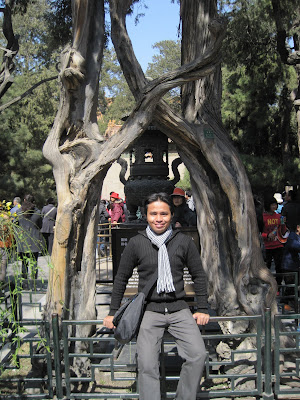
A pair of 400-year-old pine trees intertwined, symbolizing the unity of the emperor and empress. It was awkward to pose in front of it as the line of those who wanted to have their photos taken in front of it was composed of lovers. 
               Forbidden City as seen from the Jingshan Hill and yes I walked from the southern gate to the hill.                              

Wednesday, May 23, 2012

Wangfujing Street : Exotic Food Trip

              Wangfujing is a popular shopping area in Beijing like Qianmen Street but the reason I went there was not just to shop for souvenirs but also to check out what many Beijing tourists are raving about. There is something else that Wangfujing is famous for especially among westerners. I'm talking about the long line of food stalls that come to life in the evening on the side street that offer unusual delicacies. You might think that  they're the same as those you've tried in Thailand, but no, those fried crickets and bugs in Bangkok will sound like regular potato chips.In Wangfujing you'd encounter skewered animals that you never thought were edible like starfish, seahorse ,salamander (that ugly creature I saw in Hong Kong) and scorpions, GIANT ! scorpions.


I never thought that scorpions could grow this big
Snake and Snake Skin Anyone?


                        Aside from the exotic food I also had fun reading the signs on some stalls
Assortend?
ICE- CREN sounds like ICE- CREAM
         If you get to visit Beijing you should include this in your itinerary. I guarantee you this is an adventure you will never experience anywhere else. I did not dare to eat those stuff  though but I enjoyed watching people's reactions and taking pictures. Aside from the exotic foods there's a bunch of affordable and yummy common Beijing food being sold like my favorite meat kebabs.